Timeline of the struggle for Bosque Panul
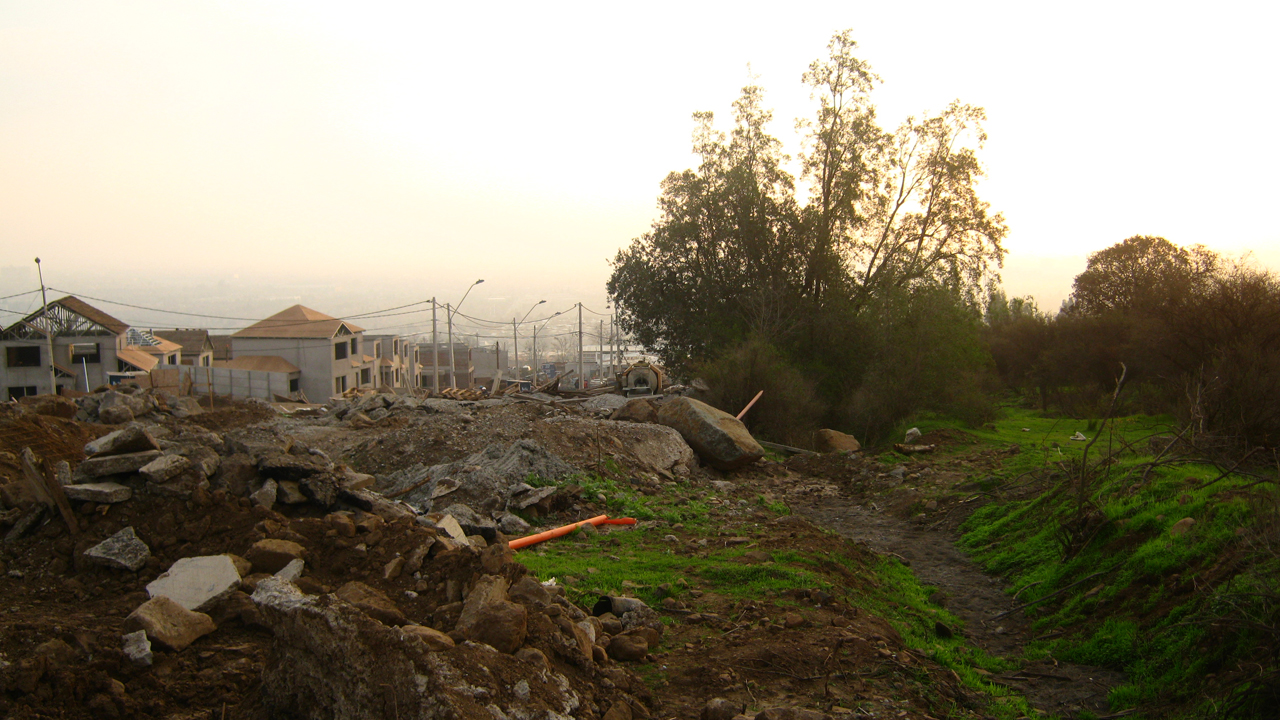
1968 La Florida's Municipal Zoning Plan (PRC) sets the urban boundary at the Canal San Carlos. The precordillera remains a rural zone.
1978–1988 Fundo El Panul, covering 534 hectares and owned by the Bacteriological Institute of the Universidad de Chile, is privatized and auctioned off during the dictatorship to a single bidder — businessman and close personal friend of Augusto Pinochet, Vicente Navarrete Marinot — for the price of a 2CV car at the time, according to the fundo's workers. This information was later confirmed by a brother of the new owner.
1993 May 3. The Quebrada de Macul landslide leaves more than 27 dead, 400 homes destroyed, and 30,000 displaced. This sharply awakens residents' awareness, as many live in areas of risk and danger.
1994 The new Metropolitan Zoning Plan of Santiago (PRMS) is published, raising the urban boundary in La Florida to elevation 1,000 meters above sea level. It also permits real estate mega-projects — entirely at odds with the precordillera's geographic characteristics — despite the recent landslide.
1996 Under Mayor Gonzalo Duarte, the Municipal Council commits to not accepting real estate mega-projects in the precordillera. However, when the company Synergia submits a preliminary project to build 8,000 housing units at Fundo Macul Alto, the Directorate of Works ends up approving it.
1996 Following protests from residents, the Municipality later rejected the project. The company took the matter to court, and the Supreme Court ordered the Municipality to uphold the project's approval. The company commits to residents to reduce the number of homes to 3,900. Currently, more than 5,000 are being built.
1996 October. With the support of residents, the Municipality drafts a Sectional Plan in record time (6 months) to protect the precordillera. This plan will inexplicably be discarded years later.
1997 November 25. Residents occupy the Quilín roundabout to demand protection of the piedmont, causing a traffic jam that lasted three hours.
2001 Under Gonzalo Duarte's administration, the new PRC is drawn up — with no protective measures for the precordillera from the sectional plan included. The piedmont is left unprotected once again.
2005 Newly delivered homes in Lomas de Lo Cañas suffer severe flooding, as do the neighborhoods of Las Perdices, El Esfuerzo, and Santa Teresa. Macalto failed to implement stormwater mitigation measures, and to this day the problem remains unresolved.
2006 May. In the face of serious governmental negligence and the unprotected territory, residents form Red Ciudadana por la Defensa de la Precordillera — an organization that will seek to protect the entire precordillera of La Florida and Puente Alto, especially the native forest surviving in Fundo Panul.
2006 September. The first open walk to the forest is organized. 100 residents commit to working for its protection.
2006 November. More than 200 people attend the second organized walk. From this point forward, Red will continuously organize walks to help people get to know Bosque Panul. To this day, hundreds have been held — many with educational institutions and social centers.
2007 May. First mass assembly of Red, with more than 20 organizations participating.
2007 June. Red organizes a march that reaches the entrance of Bosque Panul, demanding its protection. The community calls for the creation of a Public Park.
2007 August. President Michelle Bachelet commits to protecting Panul. She receives a boldo branch from the residents. She refers the matter to the National Property Agency.
2008 January. In a public hearing attended by more than 300 people, the Municipal Council unanimously commits to amending the PRC to protect the piedmont.
2000–2011 Both the administrations of Pablo Zalaquett and Jorge Gajardo systematically refuse to begin the amendment process to protect Panul.
2008 August. The owners of Fundo El Panul (the Navarrete Rolando family), through their company Gesterra, submit a preliminary project for the construction of 1,302 housing units in Bosque Panul. They simultaneously request permits from the Environmental Impact Assessment System (SEIA).
2009 January. Thanks to pressure from Red, CONAF and SAG visited Panul and officially certified for the first time that a native forest of great importance existed there.
2009 September. Red and BOM (bosque o muerte / forest or death) convene a march-caravan that travels through several streets of the district, alerting people to the grave situation facing the forest.
2009 November. Red organizes a carnival in the Santa Teresa neighborhood. More than 15 bands, circus schools, and hundreds of people bring to life a moving event in an area destroyed by the 1993 landslide.
2010 April. Gesterra, through Felipe Bañados, director of Protege, offers Red a "park" — without land ownership — above the 900-meter elevation line, in exchange for withdrawing opposition to the project. Red rejects this offer, making clear that it will not rest until all of Panul is recovered.
2010 October. Under pressure from Red and the Environmental Law Clinic of the Universidad de Chile, the SEIA requires Gesterra to submit a full Environmental Impact Study (EIA) — the first time a real estate project enters through this process.
2011 May. In the face of authorities' inaction, Red occupies the Council in its May 4 session. The Council president, then-councilman Rodolfo Carter, promises amendments within two months.
2011 June. Four days before being appointed mayor of La Florida by the Municipal Council, Rodolfo Carter approves the real estate preliminary project at Fundo El Panul, but commits to urgently beginning the PRC amendment. Red again occupies the council, which ends abruptly with two people detained.
2011 October. The Municipal Council unanimously approves the budget (90 million pesos) for the Risk and Environmental Protection Study (ERPA) — a prerequisite for amending the PRC. Red supports the Urban Planning Advisory Office in drafting the technical specifications for the ERPA.
2011 December. Red presents the Panul conflict to the Senate's Environment Committee, demonstrating serious irregularities in the process. The Committee is alarmed and calls for a second session with all parties involved (the mayor and Directorate of Works of La Florida, the SEREMI of Housing, CONAF, and others). Meanwhile, the Urban Planning Advisory Office drafts a timeline to accelerate PRC amendments, under which the tender for the study (ERPA) would open on December 15, 2011, and be awarded on January 15, 2012.
2012 January. Despite having Council approval, Mayor Rodolfo Carter refuses to release funds for the ERPA, claiming a lack of resources, and requests that the SEREMI of Housing, Marisol Rojas, take charge of the study — handing control of the amendment process to the Ministry of Housing, delaying the process by two years. Earlier, Marisol Rojas had improperly pressured the Director of Works to approve the real estate preliminary project. A second Senate presentation is held, and Carter again commits to amendments in the near future.
2012 January 17. Thanks to the work and pressure of the organized community, the Environmental Assessment Service definitively rejects the real estate company's Environmental Impact Study, "for lacking essential and relevant information to allow for evaluation." The community celebrates. The municipality has a golden opportunity to protect Panul.
2012 January 28–29. In a skillful move, just months before the mayoral elections and days after the community's victory, Mayor Carter calls a public consultation on the precordillera — a secretive process that the mayor constantly obstructed. Twenty-one thousand five hundred La Florida residents vote in favor of PRC amendments to protect the entire precordillera (99%). Red organizes a march to the municipality to encourage voting for protection, and deploys volunteers at all polling stations to inform people about the conflict.
2012 April. The documentary "El Nativo Respira" premieres at the Arte Alameda cinema to an audience of 200. A second premiere follows at Galpón Victor Jara. The documentary shows the intense work of residents to stop the real estate project.
2012 June. Red organizes a march urging the municipality to amend the PRC as soon as possible.
2012 November 9. A freeze on construction permits in Panul is granted to the municipality — which has remained in effect to this day — in order to develop a new Zoning Plan. Unfortunately, the municipality's proposal still permits real estate mega-projects and other types of development.
2012 December. The first "Forest Assembly" takes place, a space in which more than 200 people from various territorial organizations converge to begin giving life to the community park project in Bosque Panul — the only alternative that will guarantee its definitive protection.
2012 December 5 and 8. Two major fires and three smaller outbreaks burn more than 35 hectares of Bosque Panul. More than 100 community residents came to fight both fires. Firefighters from Ñuñoa certify intentionality. The PDI launches an investigation. No suspects are found. The community suspects the real estate company, as the fires occurred in the same area as the proposed project.
2013 January. Red organizes a well-attended march along Vicuña Mackenna. 2,000 people walk to the beat of tinkus, batucadas, and street bands, ending at a rally outside the municipality to demand urgent protection of the forest.
2013 April. First national march for the recovery of water. More than 150 territorial organizations and 10,000 people. Red participates under the slogan "from forests springs water." The second "Forest Assembly" is held.
2013 August 21. The municipality decides to cancel its contract with the SEREMI for the risk and environmental protection study and take charge of it itself. It commits to having it ready by February 2014.
2013 October. The well-known program "31 minutos" films an environmental segment in Bosque Panul — an episode that will air in the fourth season.
2013 December. Thousands of people attend the carnival march for Bosque Panul, to convert it into a Community Park — that is, under the control and management of residents.
2013 December. The Piñera government drafts regulations that would exempt real estate projects like the one in Panul from the Environmental Impact Assessment System.
2014 February. The results of the municipal study are released — but they only address "risks" and not "environmental protection," by explicit order of the mayor to the academic in charge, Francisco Ferrando. The truncated study will thus serve to support the mayor's proposal, which, under a false promise of protection, clears the path to negotiate the project in exchange for handing over part of the forest — sentencing Panul to death.
2014 May. More than 200 people attend the "Heritage Day" celebration in Bosque Panul, organized by Red. It is the first time in Chile that "unofficial" or citizen-organized activities outnumber "official" ones organized by the State — considering that the State only recognizes Cultural Heritage and not Natural Heritage as Red does.
2014 June. Despite Mayor Carter having a council majority, the Municipal Council rejects the PRC proposal, for failing to incorporate "environmental protection" and zero construction in the forest. The mayor states that if he had included it, he would have to expropriate, and would not have the resources — demonstrating a profound technical misunderstanding of the issue, since Panul's value would drop dramatically if the risks and environmental value were officially recognized.
2014 June. Faced with the bleak institutional landscape, Red launches an offensive to achieve the expropriation of Panul.
2014 July. Regional Governor Orrego commits resources for the expropriation.
2014 August 16. March for the expropriation of Panul. More than 5,000 people march through the streets of La Florida demanding the expropriation of Panul — the largest march in the district's history.
2014 September. Regional Governor Orrego visits Panul and changes his position, committing to "a certain type of protection," as expropriation would be "very difficult."
2014 October. The environmental segment by Juan Carlos Bodoque on Bosque Panul airs on "31 minutos." Millions of people across the continent learn about the struggle to recover Santiago's last native forest.
2014 November 8. For the third consecutive time, a freeze on construction permits in Panul is granted — based on a proposal by the governor that would only protect 10% of the area intended for destruction, a proposal that now amounts to nothing. Incredibly, both the mayor and governor once again have time to begin official protection in line with community demands.
2015 January. The Municipal Council approves Carter's proposal, thanks to the favorable votes of Nicanor Herrera (PS) and Marco Espinoza (DC), opening the door to the real estate project. Carter commits to conducting a "biodiversity study," whose preliminary results establish that Panul contains two forests — one more important than the other — so the project could be built in the less important one (the thorny scrubland forest). This had been denounced years earlier by Red. In this way, the mayor seeks to allow the real estate project to proceed in exchange for the ownership of the rest of the fundo. The serious problem is that this forest is vital to the existence of the entire rest.
2015 August. More than 700 cyclists pedaled in the "Cicletada por el Bosque Panul," riding through the main streets and arteries of La Florida, arriving at the entrance of the municipality where hundreds of signs were hung demanding the care and protection of the forest.
2015 December. First Environmental Monitor Training Workshop for Bosque Panul, in which about 20 people eager to learn about the forest and become its future environmental monitors participated.
2016 January. It is discovered that Amendment No. 9 to the Municipal Zoning Plan — which was supposedly meant to protect Bosque Panul from potential residential construction, voted on by the Municipal Council and promoted by Rodolfo Carter — turned out to be a deception of the community by the municipality, as it in fact permits the construction of buildings and housing.
2016 February. A citizen investigation is published revealing how the Navarrete Rolando family has inflated the price of Fundo Panul in order to prevent its expropriation due to its excessively high cost.
2016 June. Real estate company ENACO fells approximately 1,300 m² of native forest to make way for a new phase of construction of the "Cumbres de la Viña" real estate project, located adjacent to the forest.
2016 June. First Bosque Panul Reforestation Day, in which around 300 native trees were planted. Two more reforestation days were held that year (July and August).
2017 January. A fire in Bosque Panul affects more than 2 hectares of native forest. It did not spread further thanks to the action of the Brigada de Emergencias Alto La Florida (BEAF). Those responsible were minors whose camping stove overturned while they were heating food.
2017 April. A fire on Cerro Santa Rosa consumes 4 hectares of native forest. The swift action of BEAF was able to stop the event. Those responsible were a group of young people who lit an unnecessary campfire.
2017 May. Red por la Defensa de la Precordillera conducts an investigation that exposes the connections between government authorities and the owners of Fundo Panul.
2017 May. Fourth Reforestation Day in Bosque Panul, with more than 200 native trees planted. Two more days were held that year (July and August).
2017 June. The Ministry of Public Works and the Municipality of La Florida "clear" an important ravine in Bosque Panul, nearly completely destroying it and reactivating a ravine that had been stable and posed no danger to the population.
2017 October. The MOP takes no concrete action to repair the damage caused to the destroyed ravine in June.
2018 January. A letter signed by distinguished academics and numerous organizations and neighborhood associations is delivered to President Bachelet and all relevant ministries, along with the municipalities of La Florida, Peñalolén, La Reina, and Puente Alto — explicitly stating that all signatories seek the official and definitive protection of Bosque Panul.
2018 April. The Environmental Tribunal accepts the lawsuit filed against the company Gelymar (whose owners are also the owners of Fundo Panul) and the Ministry of the Environment for the environmental damage caused over more than 30 years in Bosque Panul.
2018 October. The Navarrete Rolando family's (owners of Fundo Panul) intentions to destroy the Hualpén Peninsula Nature Sanctuary (Biobío region) to make way for high-value housing are revealed. Also exposed is the pollution caused by the company OXIQUIM (a holding in which the Navarrete Rolando family participates) in Quintero Bay.
2018 December. The first wildfire detection tower in Santiago's precordillera is inaugurated — funded by residents and operated by the Brigada de Emergencias Alto La Florida.
2018 December. The first children's competition "Dibuja el Bosque Panul" (Draw Bosque Panul) is held, aiming to promote the care and protection of the forest through artistic and creative expressions by children between 4 and 10 years old.
2019 Summer. The community organized in Community Park carries out irrigation in the ecological restoration area.
2019 March. A private meeting between the Municipality of La Florida and representatives of real estate companies comes to light, in which a map was presented showing points representing "real estate developments" for the district in 2019 — including points within Bosque Panul. The community awaits an official and logical explanation for this silent meeting.
2019 April. The launch of the book "Bosque El Panul" takes place, addressing the conflict, the struggle, and the community work carried out for more than a decade — with events told by the very people who lived them.
2019 April. Award ceremony for the first "Dibuja el Bosque Panul" children's competition, held during December 2018 and January 2019.
2019 May. Community Organized in Community Park carries out — in three self-managed sessions — the fencing of the ecological restoration area.
2019 July. The Environmental Tribunal rules in favor of the forest and orders the Superintendency of the Environment (SMA) to begin a process for the company to undergo environmental assessment and repair the enormous damage its industry generates.
2019 September. Regional Governor Rubilar keeps Bosque Panul unprotected. Following a working session with the governor of the Metropolitan Region, she fails to carry out the tasks she had committed to in order to protect Bosque Panul.
2019 October. The Piñera government proposes to exempt Bosque Panul from environmental assessment. The justification for Piñera's proposal centers on economic growth as the primary axis — without sparing environmental costs or damages — through an amendment to the SEIA, which is already a permissive system.
2019 December. An internal investigation reveals an environmental crisis in La Florida: more than 150 hectares of Precordillera destroyed during Carter's administration.
2020 March. Warning issued about how Amendment No. 15 to the PRC attempts to create zoning for construction in Panul.
2020 July. Another small victory for Bosque Panul. Extraction of 3,500 tons of sand will be carried out as proposed by the community through a plan developed by the community itself.
2020 July. Municipal guards enter the forest on motorcycles, expelling visitors and damaging flora and fauna in their path.
2020 October. Owners of Fundo Panul fail to comply with the plan for the removal of industrial waste (sand) issued by the community — entering with heavy machinery in sensitive areas of the forest, causing major damage to the ecosystem. The community, which had been continuously monitoring on site, reported this to the Tribunal and the SMA and halted the machinery.
2020 November. Municipality of La Florida seeks to urbanize the entrance to Bosque Panul — since the "three points" presented to real estate investors by the Municipality coincides exactly with the location of Colegio Pablo Apóstol, sold at this time, raising serious doubts about the future of this space and the gateway for new real estate projects, while also leaving hundreds of families without school enrollment for the coming year.
2021 February. Oxiquim-Gesterra of the Navarrete Rolando family files suit against the community monitoring the removal of sandbanks — seeking to prevent the community from entering the forest so they can contaminate and damage it with impunity, and thus produce grounds for the closure of Bosque Panul.
2021 March. Real estate company Gesterra submits a project to urbanize Bosque Panul. Following various on-site suspicions, it is confirmed that this company (also owned by the family that owns Fundo Panul) seeks to urbanize through a subdivision that takes advantage of the PRC drawn up by Carter in 2015 — which permits sewage systems, roads, and street lighting. In this way it aims to install roads according to the district's Road Plan (2009), which would cause the destruction of this living lung.
2021 March. The subdivision preliminary project is confirmed, with at least 7 large lots, submitted in January to the Municipal Directorate of Works (DOM). After being called liars by Carter, the truth comes out. This project seeks to extend Avenida Central and Rojas Magallanes into the forest.
2021 The community continues to advance in the construction of a Community Park through forest assemblies and various actions.
Despite tireless meetings and commitments with various authorities at all levels of state administration, official protection of Bosque Panul's native forest has still not been achieved. We have built an arduous territorial effort, with daily activities in the forest and several mass marches. The organized community has grown over these years, and today the goal is the expropriation of Fundo El Panul and the precordillera of La Florida and Puente Alto — to create a great community park under the control of local residents.
The content expressed in this article is the responsibility of its original authors and does not necessarily represent the views associated with the Panul Para Todos project.
The information archived in Archivo Panul was collected using automated tools, so there may be inconsistencies between what is presented here and the original link. You can visit the original link at the top of this article.