Santiago on the brink of an environmental crime
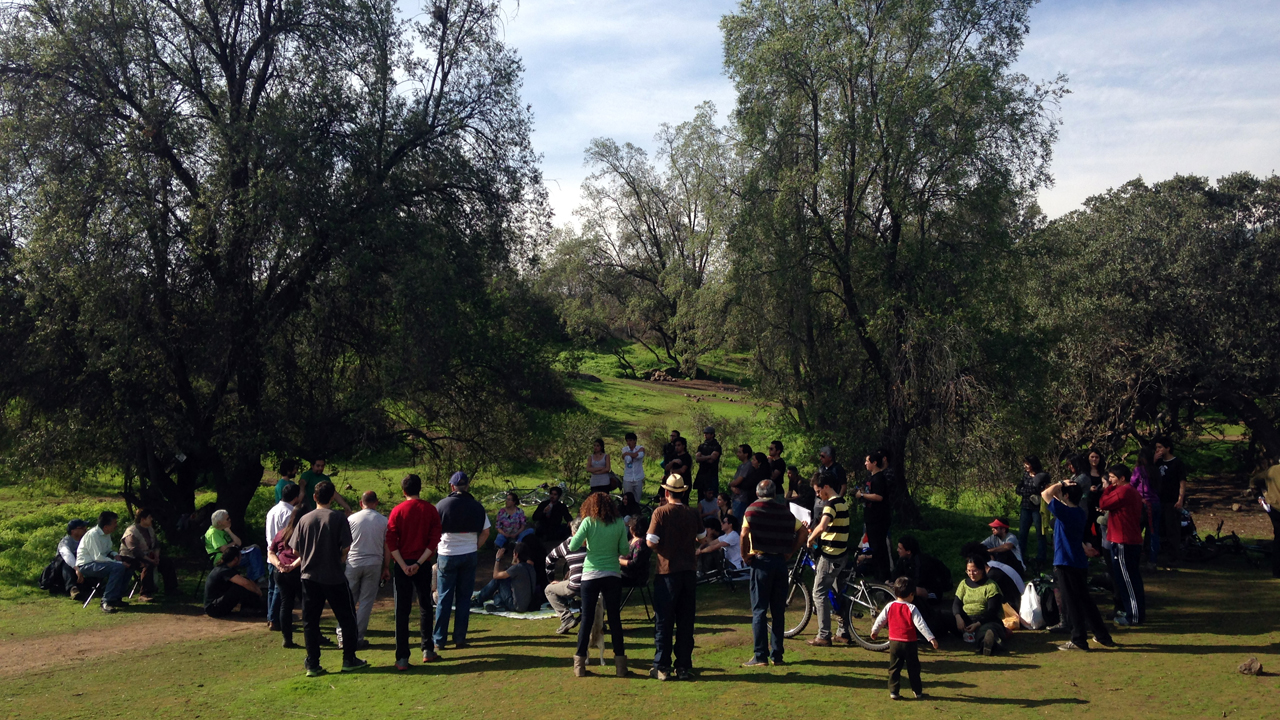
We are speaking of Bosque Panul, the last remnant of native vegetation in the capital, which — after a decade of defense by residents — has still not found an institutional solution. Neither the State nor the municipality has taken action, and today the forest continues under real estate threat. To be sure, everyone has pledged to protect it: ministers, lawmakers, intendants, mayors, and councilmembers alike. Yet none has followed through.
A matter of common sense.
If you went out to the street and asked someone passing by whether they agreed with destroying a native forest to replace it with houses, the most likely answer would be no. If you further told them it was the last forest within the city of Santiago, located in one of the districts with the fewest square meters of green space per resident, the answer might be more emphatic. All this, without even mentioning the recent studies warning about the risks of living there.
We are speaking of Bosque Panul, the last remnant of native vegetation in the capital, which — after a decade of defense by residents — has still not found an institutional solution. Neither the State nor the municipality has taken action, and today the forest continues under real estate threat. To be sure, everyone has pledged to protect it: ministers, lawmakers, intendants, mayors, and councilmembers alike. Yet none has followed through.
Legal obstacles or lack of political will?
Residents demand that the State expropriate Fundo Panul (privatized under the dictatorship) and establish a park land use, together with the adjacent plots. In total, there are approximately 1,000 hectares containing a significant mass of native vegetation, 180 of which lie within the urban area.
Both La Florida's mayor Rodolfo Carter and Santiago's Intendant Claudio Orrego have stated that a public park could not be created in the area, as it is privately owned and within the urban boundary. This is not true, since the law itself empowers the State to expropriate in order to protect environmental heritage and for reasons of public utility (see Art. 19, No. 24 of the Constitution, and Arts. 59 et seq. of the General Law on Urban Planning and Construction).
To do so, the forest must be designated as a park through the Zoning Plan — municipal or metropolitan. That is, both the municipality and the Intendant have the power to act to prevent the destruction of Panul. What has happened so far?
Mayor Rodolfo Carter distances himself from his responsibility.
The Municipality of La Florida has systematically refused to create a park in Panul. The mayor's last Zoning Plan proposal maintained private ownership, subdivided the forest, and permitted invasive construction (Municipal council rejected La Florida's mayor's proposal to allow construction in Panul). At the council session where this proposal was rejected (despite the mayor holding a majority), the mayor stated that creating a park in Panul would legally require expropriating at market value, and the municipality supposedly lacked the funds for this due to Fundo Panul's high value. The community maintains that this "high value" is false and suspects the mayor's true intentions. (See sidebar note)
THE EVER-ELUSIVE EXPROPRIATION.
When a park is created through the Zoning Plan (municipal or metropolitan), the law empowers the State to expropriate the land. This process has no established deadline, which means there is sufficient time to raise the "market value" of the property, which is ultimately set by the courts.
This is why there has been so much speculation about the price of Panul — a crucial point for achieving its expropriation. The State carried out a valuation completely divorced from reality, treating the forest as urban land and placing its price at 40 billion pesos, whereas Red Precordillera has estimated its value at no more than 3 billion. This point is serious, and the consequences are evident: the State abandons the expropriation — or, put differently, maintains private ownership of Panul.
Red Precordillera states that, in calculating the market value, one must consider that this is an area with no infrastructure of any kind, protected by the native forest law and Supreme Decree 82 (Ministry of Agriculture), both of which prohibit logging. Furthermore, it was the State itself that incorporated Panul into the urban area after the auction of the fundo — meaning the State cannot compensate and enrich the owner millions of times over for something it caused itself and now seeks to remedy. Finally, the real estate project is illegal and was rejected after 4 years of review, and studies now identify serious risks associated with living there. All of this without considering that Fundo Panul belonged to the Bacteriological Institute of the Universidad de Chile and was "auctioned" during the dictatorship (1979) for the price of a Citroën 2CV of that era.
Today, the mayor is preparing a tailor-made arrangement for the real estate company through a flora and fauna study that will not acknowledge the true extent of the forest. This study, according to the municipal magazine "El Floridano," "will allow us to identify the places that must be conserved and protected. In short, we will know where and in what condition the sclerophyllous forest is located" — which is contrary to the risk study that the municipality itself commissioned months ago, which states that native forest exists throughout the entire Fundo Panul. (See biogeosystem map, risk study section, municipality's web portal)
The real reasons for the third freeze.
Seeing the municipal doors of Panul's protection closing, residents formally asked the Michelle Bachelet government to create a park through the Santiago Metropolitan Zoning Plan.
While at first Intendant Orrego appeared inclined toward expropriation, after the inflated valuation he changed his mind and proposed an amendment that would not create a park, but would merely restrict the urban land use on a 20-hectare strip (at the edge of the 900-meter contour).
This was the reason for the initiation of the third freeze on construction permits in the area, which runs until February 8, 2015. That is, if Panul is not protected, the company can submit its real estate project as of that date. This freeze only affects the 180 hectares within the urban area and does not apply to Macul Alto or the northern section of La Florida's precordillera.
Red Precordillera rejected this meager proposal from the Intendancy, and now awaits a response from the central government or the municipality that is proportionate to the conflict: a public park in Panul for all of Santiago.
While the State sleeps, residents advance toward the community park.
Over the years, Red has developed a deep critique of the State and its management of ecosystems: the destruction and dramatic reduction of common goods such as water, copper, and forests; the exclusion of communities from decision-making; tax exemptions and private concessions of parks and reserves; a legal framework that privileges growth and investment over the life of nature; and the final disconnection of communities from their own territory and culture.
What to do when the State, which should protect nature and be the guarantor of effective citizen participation, does the exact opposite?
Red proposes the creation of a community park in Panul, managed by residents, under "official" protection. Today there is a large community that wants to actively participate in the territory that shelters it — especially since Bosque Panul is part of their culture. If it were to disappear, a way of life, of relating to the mountain and to nature, would disappear with it.
For those who love Panul, this is a conviction and a responsibility — not a slogan or cheap populism. After nearly 10 years of hard work, as its inevitable fruit, the residents want to be part of the present and future of Bosque Panul.
The outcome of this social conflict remains to be seen. For now, Panul still breathes.
Red por la Defensa de la Precordillera, communications team. December 2014.
The content expressed in this article is the responsibility of its original authors and does not necessarily represent the views associated with the Panul Para Todos project.
The information archived in Archivo Panul was collected using automated tools, so there may be inconsistencies between what is presented here and the original link. You can visit the original link at the top of this article.