Municipal Council rejects La Florida's mayor's proposal that allowed construction in Panul
• Residents must mobilize to reactivate the Zoning Plan amendment, this time with real solutions to protect La Florida's native forest. • The amendments must be ready before November so that real estate company Gesterra cannot submit its project again. • In the face of municipal negligence, the community demands the expropriation of Panul by the Bachelet administration.
• Residents must mobilize to reactivate the Zoning Plan amendment, this time with real solutions to protect La Florida's native forest. • The amendments must be ready before November so that real estate company Gesterra cannot submit its project again. • In the face of municipal negligence, the community demands the expropriation of Panul by the Bachelet administration.
The municipality-real estate company deal is exposed
Why did La Florida's mayor insist that his Zoning Plan proposal was meant to protect Bosque Panul?
Why did he push to the end for dividing the forest into one-hectare plots and allowing 140 m² constructions — which, if concentrated, could result in a mega-construction of 12,600 m²?
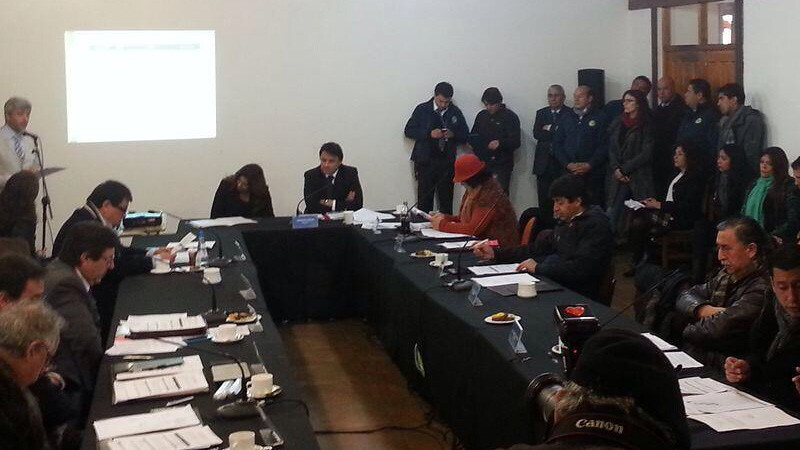
At the Council meeting on Wednesday, June 25, for the first time in many years, Rodolfo Carter declared his true intentions: he wanted the part of the forest closest to the city to be built on, so that in the upper part the real estate company would give residents a "Mahuida-style park." This is the same bait that construction companies used to approach politicians and neighborhood leaders of La Florida in 2008, confirming warnings about a deal being made behind residents' backs.
Carter spoke of building a rodeo arena, sports courts, museums, cafés, and shops. In his delusion, he thought that by allowing the real estate company some business, it would transfer land in exchange for a "swap," to build a municipal park in his own image.
But this was frustrated — not only by the five opposition councilmembers who rejected his proposal, but also by his own Alianza councilmembers, who did not attend the council session and caused Carter to lose his majority.
The mayor's two central arguments were: 1) decreeing zero construction in Panul would not allow the creation of basic park infrastructure, and 2) the real estate company would go to court, and the courts, seeing that all business was being restricted for the private owner, would force the municipality to expropriate.
The first argument is false, since although parks are areas where non-urbanization is explicitly defined, this does not prevent low-impact complementary infrastructure such as shelters, barbecue facilities, and restrooms consistent with environmental protection — as in any park subject to official protection. That is precisely why the municipality must designate Bosque Panul as a "natural heritage area" — something it has refused to do. The community was never consulted about whether it wanted to convert Panul into a new Mahuida (a private park in La Reina), with greater intervention in the ecosystem.
The second argument is worth noting, since the municipality is the one that represents the community before the courts. We, fully aware of our conduct, would never ask the municipality to act illegally: it is perfectly possible to protect Panul completely. All the scientific arguments were on the table and the municipality chose not to listen, stubbornly insisting on negotiating a "pseudo-park" behind residents' backs. Furthermore, if the courts were to order expropriation, this would elevate the issue to the level of the central government — an arena in which the mayor would lose all possibility of playing a leading role.
The real estate threat is closer than ever
Municipal negligence has resulted in a tremendous loss of time, especially considering that on November 8 the permit freeze expires and the real estate company will be able to submit a new project under the old Zoning Plan, which allows mega-projects in the area. As if this were not enough, a regulatory amendment by the Piñera government removed real estate projects — like the one for Panul — from environmental review. This could change, if the current Bachelet government has the political will to amend this Ministry of the Environment regulation and initiate the expropriation process.
Now we must do things properly and without excuses
The rejection of Carter's proposal is an important first step toward fulfilling one of the community's objectives: amending the Zoning Plan, recognizing that the native forest is an area of natural value that cannot be left to the real estate market — consolidating complete protection of Panul, which would also make expropriation of this important ecosystem less costly for the State.
The second objective has already been stated: the current government must expropriate Panul, protect it by law, and hand management of the territory over to residents.
Finally, the Bachelet administration must ensure that real estate projects once again enter the Environmental Impact Assessment System, since they cause irreversible effects on the environment — something that under current regulations is beyond any minimum environmental oversight.
The Community Park is us
We invite all kindred organizations, all the outraged people who love and defend Panul and the environment, to be more vigilant than ever. New activities will soon be called to defend our territory. We count on everyone's support to achieve this dream, which grows ever more real.
We will not be intimidated. The power is us.
Red por la Defensa de la Precordillera.
The content expressed in this article is the responsibility of its original authors and does not necessarily represent the views associated with the Panul Para Todos project.
The information archived in Archivo Panul was collected using automated tools, so there may be inconsistencies between what is presented here and the original link. You can visit the original link at the top of this article.