Chile is burning
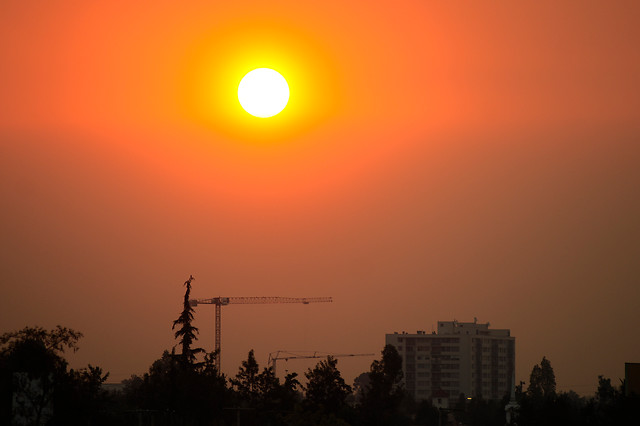
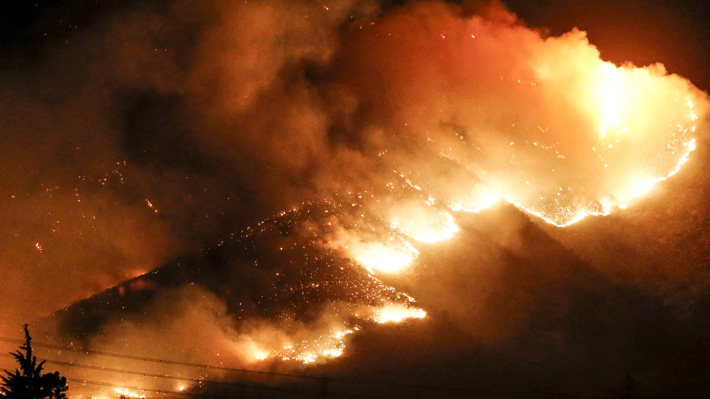
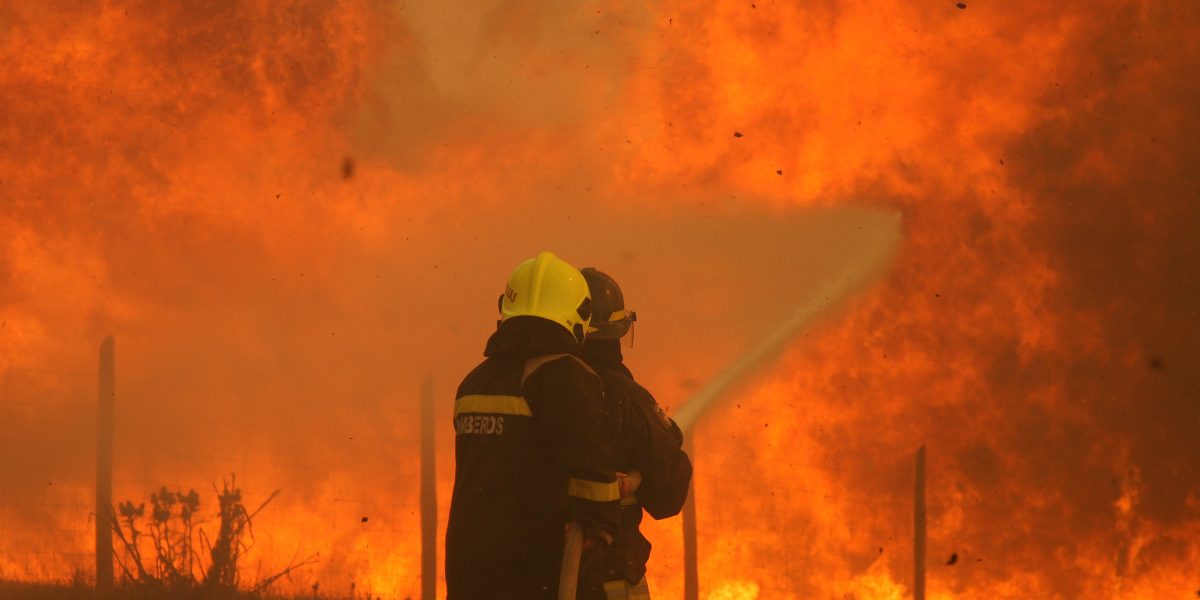
Central Chile is burning. Santiago, Quilpue, Alhue, Rancagua, and others have been under smoke for several days. In the following piece, we dig into the causes and possible solutions.
Chile is burning
A dense layer of smoke and ash covers Santiago, Rancagua, Valparaíso, and other cities and towns across the country. To date, 40,000 hectares of vegetation have been consumed, there are one hundred active outbreaks, and hundreds of people have been left without homes. In the sixth region alone, in Pumanque, 15,000 hectares have been consumed — one of the largest fires on record — which is already affecting residential areas and covers 60% of the municipality.
In Vichuquén, 2,730 hectares of fire cost the lives of 3 brigade members and left 4 seriously injured.
In Valparaíso, intentional fires are a daily occurrence and have already destroyed hundreds of homes and caused millions of dollars in losses.
The facts
In Chile and Latin America, all forest fires are caused by human action, with the exception of fires caused by volcanic eruptions or other less common causes.
The Chilean State allocates approximately 40 million dollars per year to fight fires and has around 1,700 brigade members, who receive a salary of 400,000 pesos per month. This has been criticized even by sectors within the government, with the current budget for the Ministry of Agriculture and CONAF being rejected.
When we compare these figures with other countries, Chile has a meager firefighting budget. In California alone, for example, three times the resources are allocated, they have four times as many brigade members, who receive a salary of around 3 million pesos — not counting the machinery, aircraft, and infrastructure available, which far exceeds what our country has.
In other words, we have neither the number of people, the resources, nor the infrastructure needed to cope with all the forest fires that occur.
Perhaps this is why the president of one of the CONAF brigade workers' unions blamed the authorities for the death of the 3 brigade members. By "authorities" he is clearly referring to the national director of CONAF, who in turn is appointed by the president.
The Armed Forces, who should be helping to control these disasters, only deploy 288 soldiers to fight fires, out of a total of 60,560. An institution with a budget of 5.23 billion dollars for 2016 alone should be one hundred percent devoted to fighting fires, since it is the only urgent battle we must win.
Companies in the crosshairs
All fires are caused by human action, and several of them are intentional. In Bosque Panul, for example, Fire in Bosque Panul, at the height of the conflict between real estate developers and the community. Firefighters and the PDI (Investigative Police) certified not only intent, but that the perpetrators demonstrated extensive knowledge of how to start a fire that would be difficult to extinguish.
The Quebrada de la Plata, a natural stronghold that survives the mining assault in Maipú, was ferociously set alight on the very day it was declared a "Nature Sanctuary."
Something similar occurred a few days ago in Chicauma, a genuine reserve of native vegetation besieged by real estate companies and tourism and mining firms.
And what to say of the fires that year after year affect the "Ecological Reserve" of Fundo Macalto in La Florida, where one of the largest real estate projects built in the country is under development. Macalto, owned by 4 powerful families (the Cueto clan, Sarquis, Kassis, and Zalaquett) has flouted every environmental regulation and today is pushing to continue building homes and buildings toward the mountains.
Setting forests on fire to reduce their environmental value and enable construction has become a common practice among several companies, motivated above all by the low penalties (often only small fines) they would face.
An arsonist State
The State — both the government and the municipalities — is directly responsible for the large number of uncontrolled forest fires. Not only because of the woeful allocation of resources, the low number of volunteers, or the insufficient infrastructure, but also because there is no real policy for protecting and restoring the environment that incorporates strategic ecosystems for their conservation and care.
Furthermore, it has promoted the privatization and irrational use of water, and the replacement of native forests with pine and eucalyptus plantations — far more combustible — generating extensive droughts that worsen conditions for fires. One need only look at what happens in Valparaíso, where 5 private properties with plantations surround the city, with no strategic environmental care or policy seeking to incorporate those properties into more rigorous protection — turning the city, a UNESCO World Heritage site, into a genuine powder keg.
Or the case of La Florida, where fires are common in the precordillera and Bosque Panul — a territory that neither the government nor the municipality has been willing to protect through a public park.
Certainly, protection alone will not end forest fires, but we must remember that most fires occur on private land with no protection whatsoever, where the possibility of a timely response is always delayed. Yet the current government's response is to continue with the extractive, nature-destroying model, while conceding what little is protected.
At its core, mega-forest fires are a great smokescreen covering the real problem: state negligence and the lack of an institutional policy for environmental recovery and protection.
Residents do the work
In La Florida, whose forests are besieged by real estate companies, the community has responded in a coordinated and timely manner.
Two years ago, the Brigada de Emergencias Alto Florida was created to fight forest fires. This Brigade is entirely self-managed, has a tanker truck and a space in the Lo Cañas Neighborhood Council headquarters, and has managed to stop a dozen fires thanks to early warnings and the rapid arrival and action of its members and other residents who join the effort. This has been decisive in preventing any major fires from being recorded to date. Right now it is helping to combat a large-scale fire in the Quebrada de Macul, which has already reached 100 hectares.
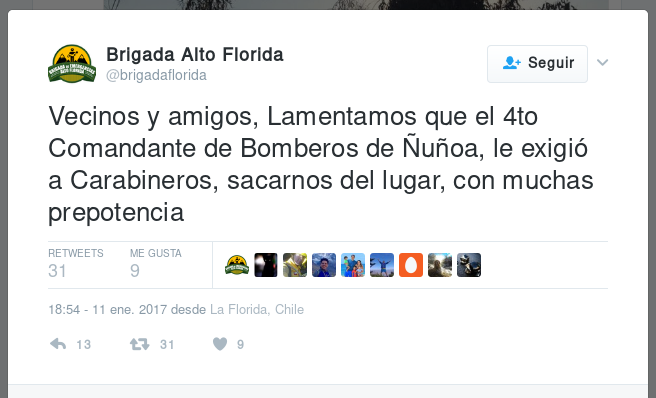
However, its work has been obstructed by the Municipality of La Florida and by the firefighters of the all-powerful Ñuñoa Fire Service, who look jealously at the Brigade's actions and the possible loss of members to this type of independent initiative. This has gone so far that, at the last fire near the Quebrada de Macul, the firefighters were blocking the Brigade's access to the scene.
Despite this, the Brigade is an example of how the community can organize to prevent its forests and ecosystems from continuing to be consumed by flames.
We cannot continue to burn. Undoubtedly the planet will find its balance. But instead of us saving the planet, we will have to save ourselves from the planet.
There will never be a "point of no return" for the Earth. There will be for humanity.
Red por la Defensa de la Precordillera. January 2017.
The content expressed in this article is the responsibility of its original authors and does not necessarily represent the views associated with the Panul Para Todos project.
The information archived in Archivo Panul was collected using automated tools, so there may be inconsistencies between what is presented here and the original link. You can visit the original link at the top of this article.